


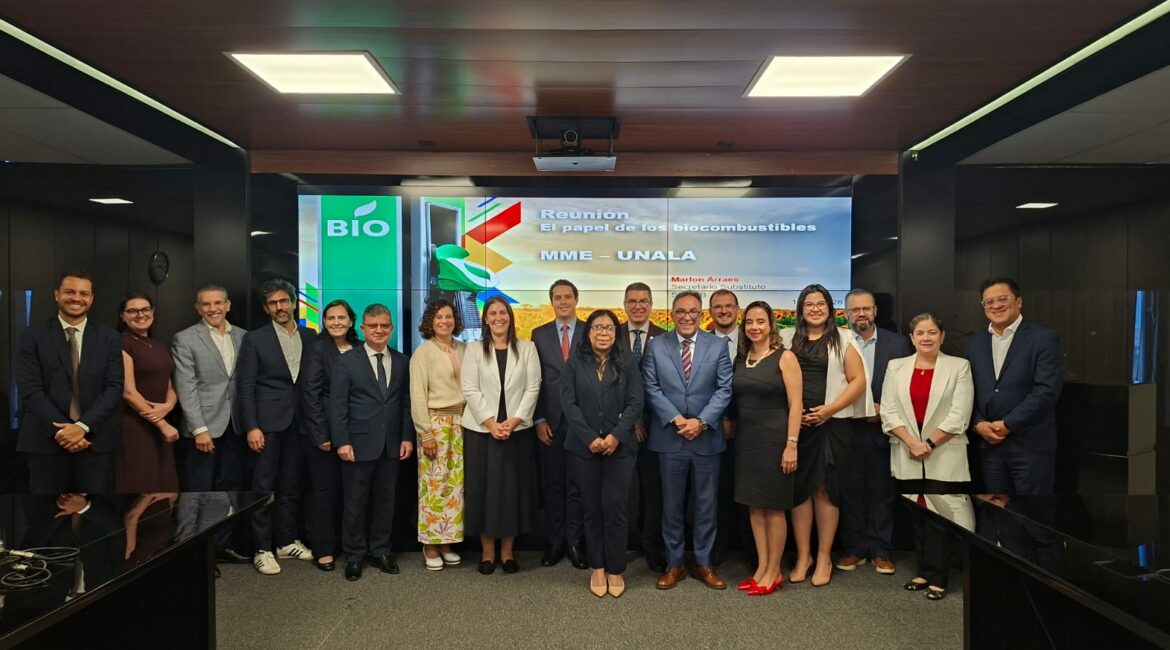
The Association of Latin American Sugar Producers (UNALA), with the support of UNICA and ApexBrasil, conducted a public-private technical mission to Brazil from August 17 to 21, 2026, focused on gaining first-hand knowledge of the country’s experience in developing and implementing public policies for ethanol use and its integration into the national energy and climate strategy.
The delegation included representatives from the sugarcane sector and government officials from Colombia, Ecuador, Guatemala, Panama, Peru, and Uruguay, providing a forum for regional exchange among public- and private-sector stakeholders involved in the development of ethanol blending programs.
The agenda began in Brasília with a meeting at Brazil’s Ministry of Mines and Energy, which was also attended by representatives of the Ministry of Foreign Affairs and the Ministry of Agriculture. Discussions addressed aspects of the regulatory and institutional framework of Brazil’s ethanol program, its evolution as a public policy, the mechanisms that have contributed to its sustainability, and coordination between the government and the productive sector.
The delegation subsequently visited the offices of the Inter-American Institute for Cooperation on Agriculture (IICA) in Brazil, where participants exchanged views on the status of ethanol blending programs across Latin America. Representatives shared the experiences, progress, and challenges of their respective countries, helping to identify both differences and commonalities in the development of these policies throughout the region.
The mission also included an important technical and industrial component. In Piracicaba, participants visited the Centro de Tecnologia Canavieira (CTC) to learn about advances in research, innovation, and technologies applied to sugarcane and ethanol production. The agenda also included a visit to the Costa Pinto sugar mill to learn about facilities involved in sugar and biofuel production and gain a closer understanding of how Brazil’s ethanol value chain operates.
As part of the visit, the delegation also toured Toyota’s plant in Sorocaba, where participants gained deeper insight into the automotive sector’s perspective and the role ethanol plays among mobility and decarbonization alternatives. The delegation subsequently visited a Raízen fuel distribution center in São Paulo, where it gained first-hand knowledge of the infrastructure and logistics processes involved in distributing gasoline blended with 32% ethanol, as well as hydrous ethanol, which can be used by flex-fuel vehicles.
The mission concluded in São Paulo with a closing session and a brief visit to UNICA’s offices, where participants exchanged reflections on the key lessons learned and opportunities to continue strengthening regional cooperation.
For UNALA, the mission provided an opportunity to gain a comprehensive understanding of a well-established public policy experience in the biofuels sector while also fostering direct dialogue between government representatives and the productive sector. The knowledge gained will serve as an input for continued analysis of alternatives to strengthen sustainable, competitive ethanol blending programs tailored to the conditions and priorities of each Latin American country.