


By Guatecaña, Guatemala –
Sustainability is part of Guatecaña’s everyday operations and is understood as a commitment to production practices that protect natural resources, generate a positive impact on surrounding communities, and promote the well-being and development of thousands of families in Guatemala.
Achieving a balance between efficiency, productivity, and sustainability is a challenge that Guatemala’s sugarcane producers have embraced with commitment and vision. This approach recognizes that environmental and social sustainability must go hand in hand with economic sustainability in order to ensure responsible, competitive, and long-lasting operations.
Through continuous investment in research and development, Guatemala’s Sugarcane Agroindustry — Guatecaña — has implemented a circular economy model that has become an international benchmark.
This model transforms sugarcane into new opportunities through an integrated system that utilizes residues and by-products to create new products, contributing to the country’s economic, social, and environmental development.
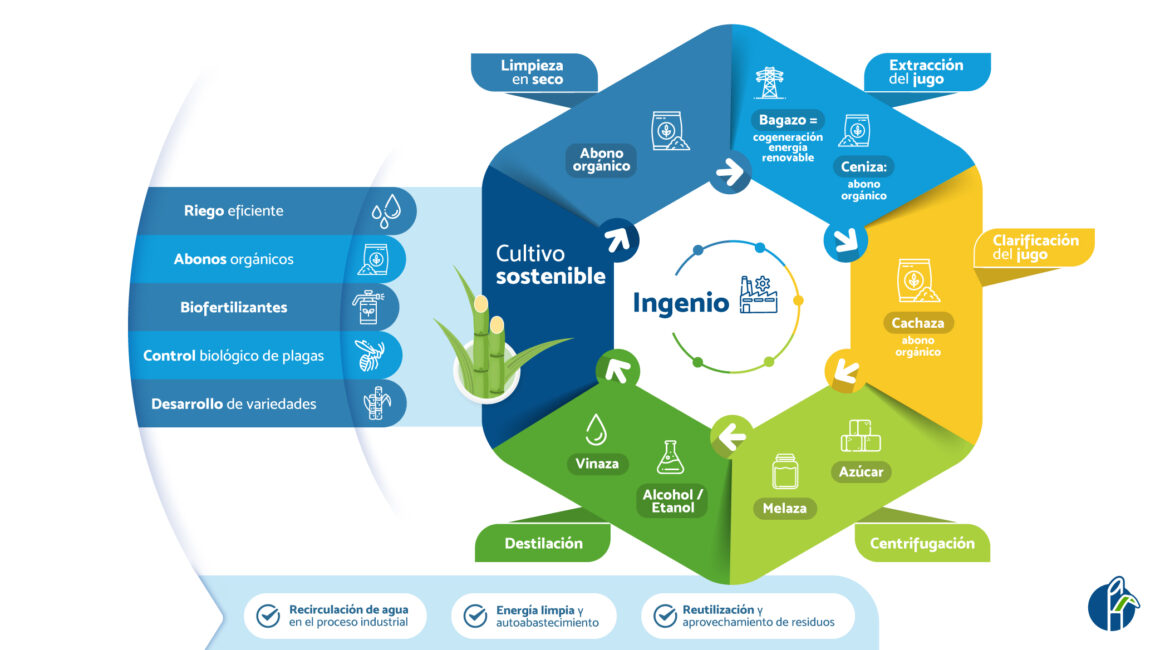
The model illustrates how the sugar mill can operate as the center of a circular system, where every stage of the production process is interconnected and residues are no longer considered waste, but rather valuable inputs. From sustainable cultivation to distillation — including extraction, clarification, and centrifugation — the sugarcane value chain enables the efficient use of water, energy, biomass, and nutrients.
The process begins in the field with a cultivation model based on sustainable agricultural practices such as efficient irrigation, the use of organic fertilizers and biofertilizers, biological pest control, and the development of more efficient crop varieties that are resistant to pests and diseases and better adapted to climate variability.
These practices are essential because they reduce dependence on chemical inputs, optimize water use, and strengthen agricultural productivity. They also make cultivation more resilient and environmentally responsible. In a circular economy, sustainability does not begin at the end of the process — it is embedded from the very design of production systems.
Once the sugarcane is harvested and transported to the mill, the dry-cleaning and juice extraction stages generate by-products that are reintegrated into the system. One of the most important is bagasse, the fibrous residue of sugarcane, which can be used for renewable energy cogeneration. This means that sugar mills not only produce sugar and its derivatives, but can also generate their own energy supply, reducing dependence on external sources and lowering emissions.
Guatemala’s sugar mills generate up to 30% of the country’s electricity consumption during the production season, which runs from November through May. The ash resulting from this process is also reused as an organic fertilizer, returning nutrients to the soil.
During the juice clarification stage, another important by-product emerges: filter cake. Rich in minerals, filter cake is used as an organic fertilizer to enrich soils. Returning this material to the field is one of the clearest expressions of the circular economy: what was once considered industrial waste becomes a valuable resource that strengthens the next production cycle.
The centrifugation process produces sugar, but also generates molasses, which can then be used to produce alcohol or ethanol through distillation processes. This stage also produces vinasse, a liquid by-product that can be used in agricultural applications under appropriate technical management.
As a result, the system does not end with a single primary product, but instead diversifies value through multiple outputs: sugar, molasses, alcohol, ethanol, renewable energy, organic fertilizers, and soil improvement solutions.In addition, water recirculation systems help optimize the use of this valuable resource and allow water to be reused throughout the production process.
The circular economy applied to the Sugarcane Agroindustry transforms the sugar mill into a more efficient, regenerative, and responsible productive ecosystem. By integrating sustainable cultivation, renewable energy, water recirculation, and waste utilization, the industry has built a model where nothing is wasted, environmental stewardship is strengthened, and long-term economic sustainability is reinforced.